


 Spanish
 Russian
 Arabic


Products Description
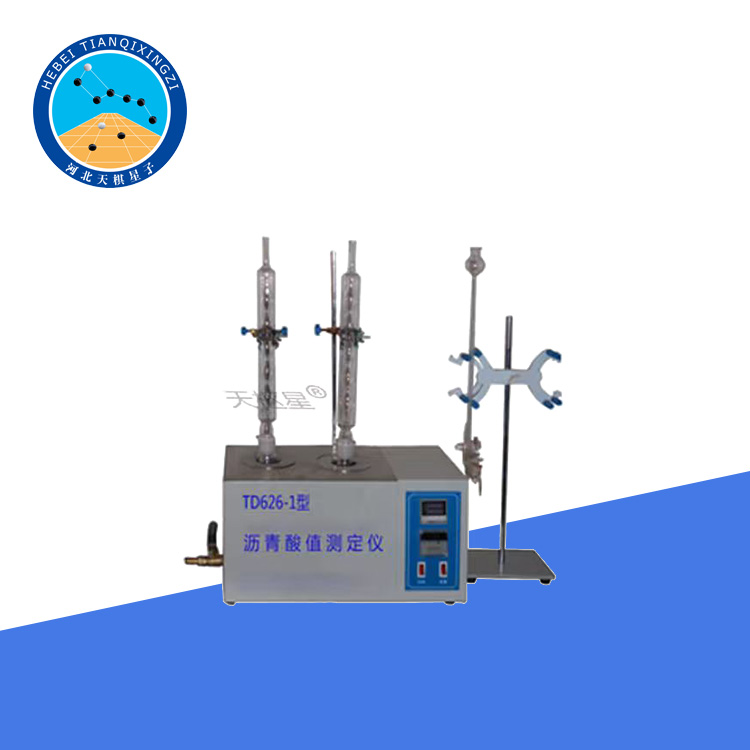
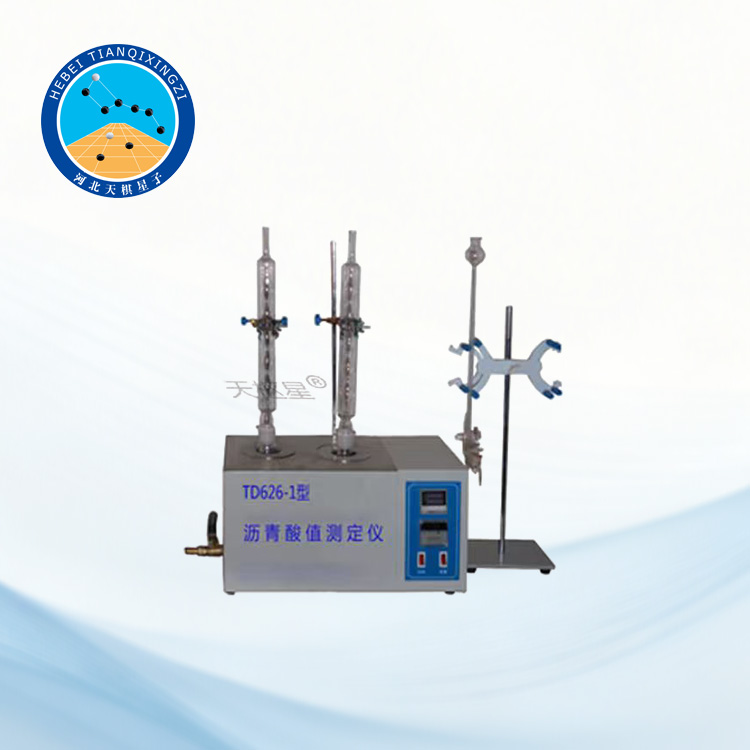
Asphalt Acid Value Tester accurately measures the acid value of asphalt and bitumen in laboratory settings, providing reliable results for quality control and research.
Asphalt Acid Value Tester
Model:TD626-1
I. Product Application:
The Asphalt Acid Value Tester is designed and manufactured by Hebei Tianqixingzi Inspection Equipment Co., Ltd. in accordance with national standards GB/T 264 "Determination of Acid Value of Petroleum Products" and GB/T 258 "Determination of Acidity of Gasoline, Kerosene and Diesel Oil," and with reference to relevant requirements of international standards such as ASTM D664, ASTM D8045, and ISO 6619:1988. It is suitable for determining the acidity of gasoline, kerosene, and diesel oil without added ethyl liquids, as well as the acid value of petroleum products.
The principle of this instrument is to extract the acidic components from the sample with ethanol, and then titrate with an alkaline solution to calculate the product's acid value.This instrument is also suitable for determining the acid value of transformer oil and turbine oil in operation according to the requirements specified in the national standard GB/T7599 "Determination of Acid Value of Transformer Oil and Turbine Oil in Operation".
II. Technical Parameters:
1. Power Supply: AC220V±10% 50Hz;
2. Heating Unit Power Range: 100W~1000W, steplessly adjustable;
3. Burette Accuracy: 0.02ml graduation;
III. Product List:
Round-bottom flask (250×24)
Spherical condenser (300/240×2 spherical)
Burette (2ml, seated)
Adjustable heater
Support rod
Condenser tube holder (pair)
IV. Methods and Procedures:
1. Preparation
1.1 Preparation of Potassium Hydroxide Ethanol Standard Solution
Take 5.6g of potassium hydroxide in a clean beaker, dissolve it with a small amount of anhydrous ethanol, and transfer it to a 1L volumetric flask. Repeatedly wash the residual potassium hydroxide in the beaker with ethanol, and transfer it to the volumetric flask as well. Finally, dilute with anhydrous ethanol to the required mark to obtain a potassium hydroxide ethanol standard solution with a concentration of approximately 0.1mol/L.
1.2 Standardization of Potassium Hydroxide Ethanol Standard Solution
Using a 0.1 mol/L standard hydrochloric acid solution,the potassium hydroxide ethanol standard solution was titrated according to conventional inorganic chemistry or analytical chemistry methods for solution preparation and acid-base titration,to determine its accurate concentration, accurate to 0.00001 mol/L.
2. Test Procedure
2.1 Prepare the asphalt sample according to the method specified in this specification. Take 3-5 g of asphalt, accurate to 0.1 mg, and place it in a 250 mL round-bottom flask.
2.2 Add 15-25 mL of benzene at a dosage of 5 mL per gram of asphalt, and reflux in a constant temperature water bath at 65℃±5℃ for 0.5 h.
2.3 Add 100 mL of anhydrous ethanol to the asphalt, seal, and let stand overnight.
2.4 Using a glass electrode as the indicator electrode and a saturated calomel electrode as the reference electrode, titrate with potassium hydroxide ethanol standard solution to the endpoint using potentiometric titration according to analytical chemistry methods.
2.5 Take a round-bottom flask, add the same amount of benzene as in step 2.2, then add 100 mL of anhydrous ethanol, stir well, seal and let stand overnight as a blank sample; then determine the volume of potassium hydroxide ethanol standard solution consumed by the blank sample according to step 2.4.
V. Calculation of Results:
The acid value of asphalt is calculated according to formula (T0626-1).
A=[56.1x(V-V0)xC]/m (T0626-1)
In the formula: A—Acid value of asphalt: [mL•mol/(L•g)];
V—Volume (mL) of potassium hydroxide ethanol standard solution consumed in the titration of the sample;
V0—Volume of potassium hydroxide ethanol standard solution consumed in titrating the blank sample (mL);
C—Concentration of potassium hydroxide ethanol standard solution (mol/L);
m—Amount of asphalt used (g).
