


 Spanish
 Russian
 Arabic


Products Description
This system is a high-precision testing solution used to analyze how materials respond to different types of mechanical stress. It provides stable and accurate control during testing, ensuring dependable results for strength and durability evaluation. Suitable for both research and industrial environments, it is widely applied in material inspection, product validation, and engineering analysis.
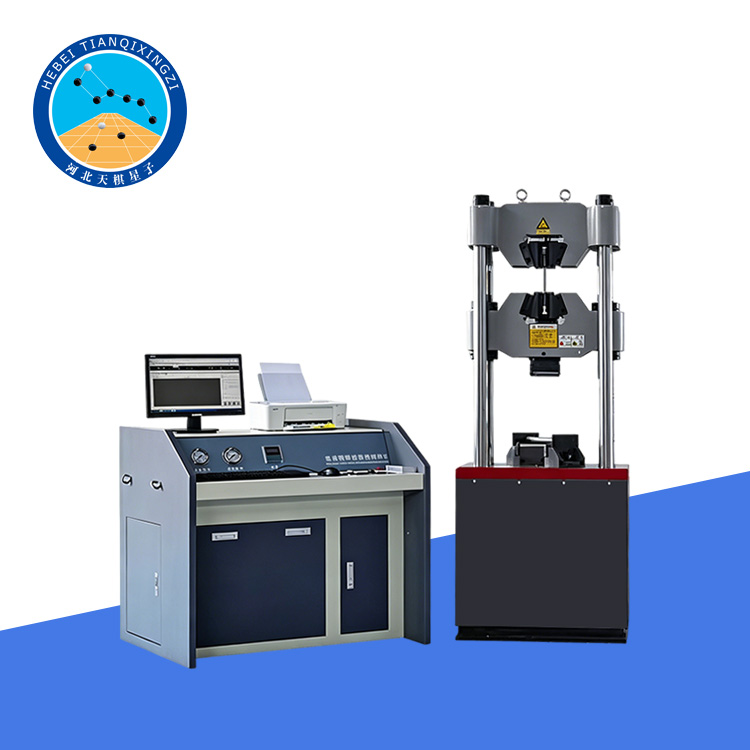
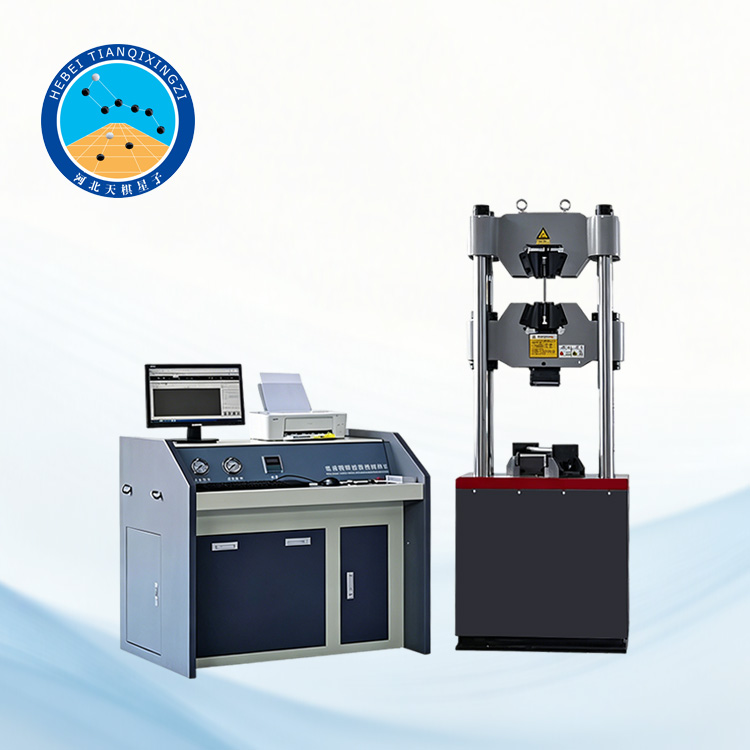
Electro-Hydraulic Servo Universal Testing Machine(Construction Site Standard Model)
Model:TDWAW-100B
I. Product Details
This computer-controlled electro-hydraulic servo universal testing machine is mainly used for mechanical property testing of metallic materials, non-metallic materials, composite materials, and related products, including tensile, compression, bending, and shear tests. It can also perform testing and data processing in accordance with various standards such as GB, ISO, JIS, ASTM, DIN, and user-defined specifications.
The machine is widely used in industries such as aerospace, mechanical manufacturing, wire and cable, rubber and plastics, and construction materials for material inspection and analysis. It is an ideal testing equipment for research institutes, universities, industrial and mining enterprises, technical supervision departments, commodity inspection agencies, and arbitration organizations.
II. Features
1. This testing machine adopts a high-precision electro-hydraulic servo valve controlled by a computer system to drive a precision hydraulic cylinder. It enables automatic control of test force, displacement, and deformation in multiple modes, and is used for tensile, compression, bending, and flexural testing of specimens, ensuring reliable and accurate performance.
2. The main machine is available in four structural configurations: A, B, C, and E types:
Type A: Upper-cylinder structure, where the piston drives the upper grip frame, and the lower grip is driven by a worm gear system.
Type B: Lower-cylinder structure, where the piston drives the lower grip frame, and the lower grip is driven by a chain mechanism.
Type C: Lower-cylinder structure, where the piston drives the upper grip frame, and the lower grip is driven by a central crossbeam worm gear system.
Type E: Newly developed lower-cylinder structure based on advanced MTS technology (USA). By replacing software and controllers, it can be upgraded to a dynamic testing machine, enabling dual-purpose functionality.
3. An independent hydraulic clamping system, employing original imported hydraulic pump units and original hydraulic valves. This ensures low-noise and stable system operation, and that the sample is firmly clamped without slippage during the test.
4. An independent hydraulic servo loading system, employing original imported hydraulic pump units and original hydraulic valves, and high-precision wide-frequency electro-hydraulic servo valves, ensures high precision, high efficiency, low noise, and rapid response of the system.
5. A branded computer system is adopted to complete parameter setting, test process control, data acquisition, processing, analysis, storage, and display during the testing process. Test data include upper and lower yield points, tensile strength, fracture strength, elastic modulus, elongation at various points, and δ0.2, etc. The control and measurement system ensures high precision and accuracy.
6. Equipped with dedicated Windows-based universal testing software, the system can measure material performance parameters according to relevant standards or user-defined requirements. It performs statistical analysis and data processing, and outputs and prints various required test curves and test reports. The software also features curve zooming, comparison, and traversal functions, making operation intelligent and convenient.
7. A powerful self-built test database is integrated, allowing test data to be saved, queried, and retrieved at any time, and enabling data transmission and conversion via local area networks (LAN) and the Internet.
8. The system is equipped with a convenient manual open-loop control function, providing direct, fast, and efficient operation.
9. A high-precision amplifier is adopted, enabling six-range force measurement (four ranges for Type A and B machines) with automatic switching, ensuring accurate, stable, and reliable performance.
10. Full automatic (or manual) control of test force, stroke, stress, and strain rate is available, enabling tensile, compression, and bending tests for various materials.
III. Technical Parameters
Test force: 100 kN
Test force measurement range: 10–100 kN
Relative error of test force indication: ≤ ±1% of indicated value
Test force resolution: 0.01 kN
Displacement measurement resolution: 0.01 mm
Deformation measurement accuracy: 0.01 mm
Tensile test space: 550 mm
Compression space: 380 mm
Piston stroke: 150 mm
Round specimen gripping diameter range: Φ6–Φ26 mm
Flat specimen gripping thickness range: 0–15 mm
Flat specimen gripping width: 70 mm
Platen diameter: Φ160 mm
Distance between two points in bending test: 450 mm
Bending support roller width: 120 mm
Bending support roller diameter: Φ30 mm
Piston moving speed: 50 mm/min
Clamping method: Manual clamping
Main machine overall dimensions: 720 × 580 × 1950 mm
Load frame (force measuring cabinet) dimensions: 1000 × 700 × 1400 mm
Weight: 1900 kg
