


 Spanish
 Russian
 Arabic

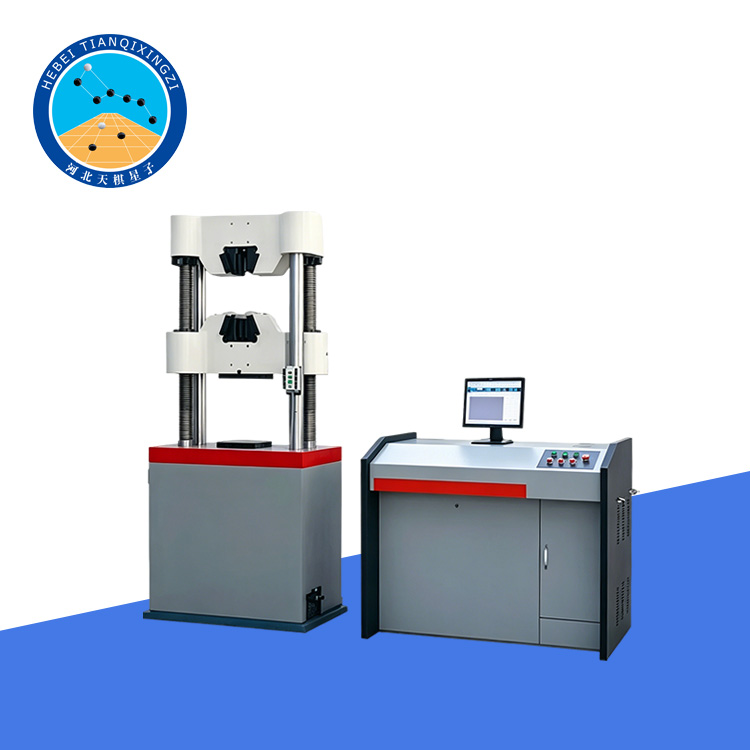

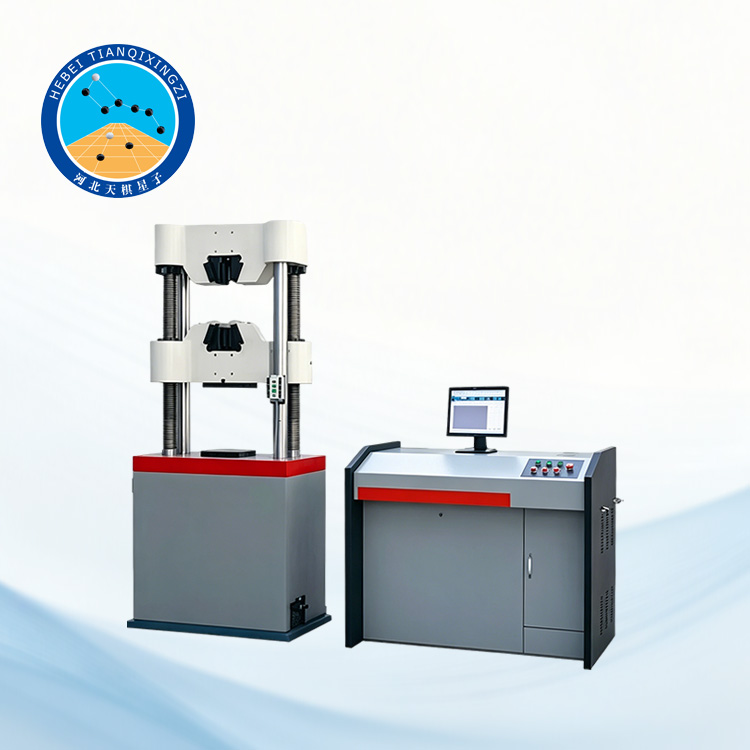
Products Description
The computer-controlled universal testing machine is a high-precision laboratory system designed to evaluate the mechanical behavior of materials under various loading conditions. It provides stable and accurate measurement of force, displacement, and deformation, making it suitable for quality control, product development, and research applications across a wide range of industrial materials.
Computer Controlled Universal Testing Machine
Model:TDWEW-100B
I. Product Introduction
This wide-screen computer-controlled hydraulic universal testing machine is mainly used for tensile, compression, bending, and shear tests of metallic materials. With additional simple accessories and fixtures, it can also be used for testing wood, cement, concrete, rubber, and related products.The machine adopts a hydraulic cylinder upper-mounted structure. The tensile testing space is located at the lower part of the main frame, while the compression and bending testing space is located between the upper cylinder base and the lower grip seat. The tensile testing space is adjusted by moving the lower grip seat.
Applicable standards: GB/T 228-2002, ISO 6892-1, ASTM E8/E8M, ISO 6892-2, ASTM A370
II. Features
1. The computer-screen hydraulic universal testing machine adopts manual hydraulic valve control to drive a precision hydraulic cylinder. It enables manual control of test force, displacement, and deformation in multiple modes, and is used for tensile, compression, bending, and flexural testing of specimens.
2. A branded computer system is adopted to complete parameter setting, data acquisition, processing, analysis, storage, and display during the testing process. Test data include upper and lower yield points, tensile strength, fracture strength, elastic modulus, and elongation at various points. The control and measurement system ensures high precision and accuracy.
3. Equipped with dedicated Windows-based universal testing software, the system can measure material performance parameters according to relevant standards or user-defined requirements. It performs statistical analysis and data processing, and outputs and prints various test curves and test reports. The software also features curve zooming, comparison, and traversal functions, making operation intelligent and convenient.
4. A powerful self-built test database allows test data to be saved, queried, and retrieved at any time.
5. Equipped with a high-precision amplifier, enabling four-range automatic switching for force measurement, ensuring accurate, stable, and reliable performance.
6. Strong self-diagnosis function and comprehensive protection features are included.
III. Technical Parameters
Test force: 100 kN
Machine accuracy: Class 1
Test force indication accuracy: ≤ ±1%
Test force measurement range: 2%–100% of full scale
Clamping method: Hydraulic clamping (or manual clamping)
Round specimen clamping diameter range: Φ4–Φ32 mm
Flat specimen clamping thickness range: 0–15 mm
Flat specimen clamping width: 70 mm
Tensile test space: 620 mm
Compression test space: 580 mm
Control cabinet overall dimensions: 1200 × 620 × 850 mm
Main machine overall dimensions: 730 × 590 × 2000 mm
Motor power: 2.1 kW
Main machine weight: 1500 kg
Clear distance between columns: 460 mm
Upper and lower platen size: Φ150 mm
Bending support roller spacing: 300 mm
Bending support roller width: 140 mm
Allowable bending span: 140 mm
Piston stroke: 200 mm
Piston moving speed: approx. 80 mm/min
Test space adjustment speed: approx. 150 mm/min
