


 Spanish
 Russian
 Arabic

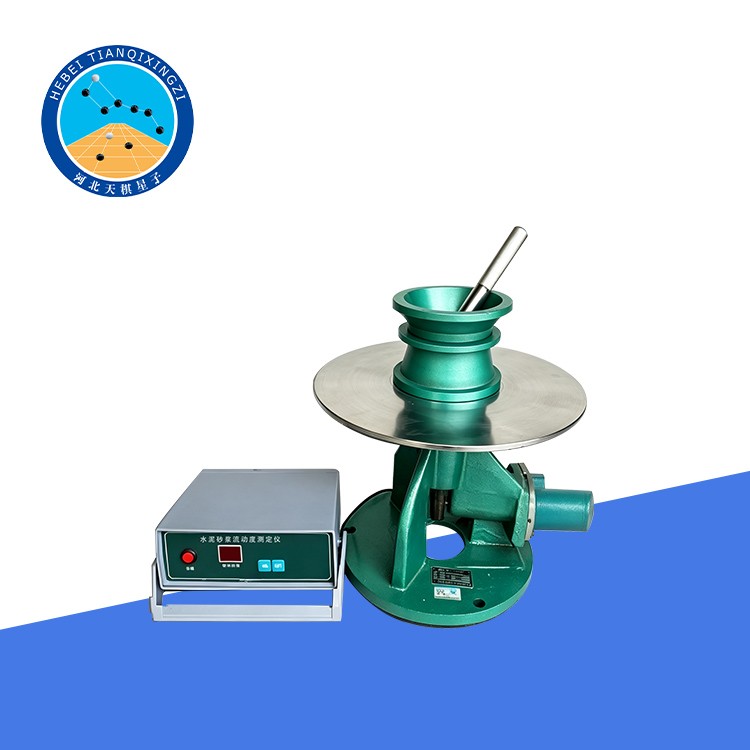

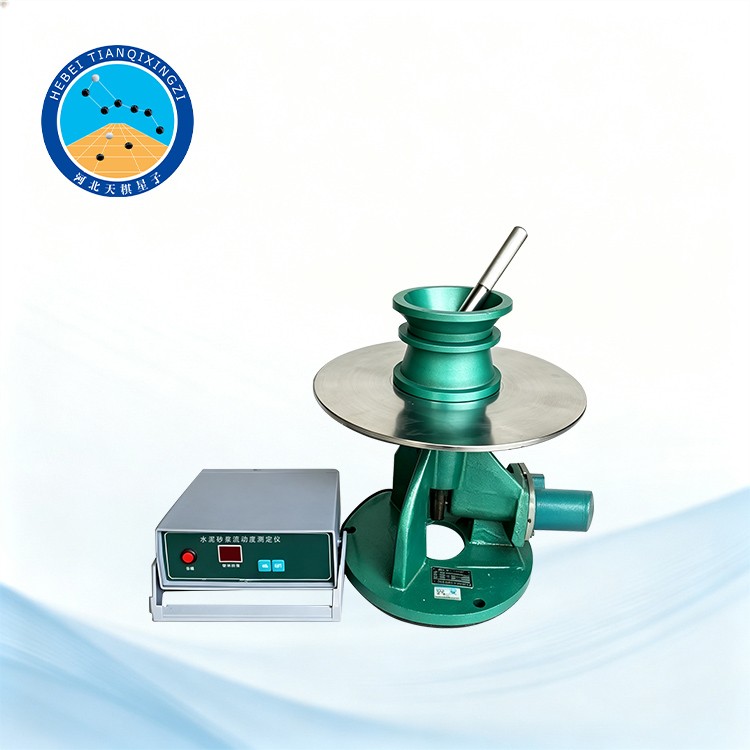
Products Description
The Laboratory Cement Mortar Flow Table is designed to determine the fluidity of cement mortar according to standard test methods. With precise drop distance and controlled vibration, it provides reliable and repeatable flowability measurements for cement and construction material laboratories.
Laboratory Cement Mortar Flow Table
Model: TD507-2
I. Overview
The Laboratory Cement Mortar Flow Table is designed for determining the fluidity of cement mortar in accordance with GB/T 2419-2005, Test Method for Fluidity of Cement Mortar. It is the designated testing apparatus specified for this method and is widely used in cement and construction material laboratories.
Reference Standards:
GB/T 2419-2005 — Test Method for Fluidity of Cement Mortar
ASTM F2029 — Standard Test Methods for Making and Testing Paper and Plastic Packaging Materials and Related Products
II. Main Technical Specifications
1. Vibrating Assembly:
Total Weight: 4.35 kg ± 0.15 kg
Vibration Drop Distance: 10 mm ± 0.2 mm
Vibration Frequency: 1 Hz
Number of Vibrations: 25 cycles
2. Tabletop Specifications:
Material: Cast steel with a hard chrome-plated working surface
Diameter: Φ300 mm ± 1 mm
III. Installation and Commissioning
1. The instrument must be properly and reliably grounded before operation.
2. Secure the instrument to the foundation using expansion bolts.
3. The instrument foundation should be made of concrete or brick-concrete construction, with recommended dimensions of approximately 400 mm × 400 mm × 690 mm (L × W × H).
4. It is recommended to place shims or spacers between the foundation and the instrument frame. The tabletop level can be adjusted by changing the height of the shims.
5. After installation, the tabletop should be level in both mutually perpendicular diameter directions.
6. After the flow table has been installed, verify its performance using the standard flowability sample (JBW01-1-1). If the measured flowability value falls within the specified allowable range compared with the certified value of the standard sample, the installation and operating performance of the flow table are considered qualified.
IV. Operating Procedure
The preparation and filling of test specimens shall be carried out in accordance with the relevant requirements of GB/T 2419-2005 and GB/T 17671-1999, or with reference to the appendix of this manual.
Before operation, use a calibration gauge to check the vibration drop distance.
If the flow table has not been used for 24 hours, run it without a specimen for one complete cycle of 25 drops before testing.
V. Maintenance
After use, clean the instrument thoroughly and remove any residual cement mortar from around the equipment. Apply a small amount of light lubricating oil to the push rod, tabletop, and cam surfaces.
If the instrument will not be used for an extended period, protect it from dust and store the controller in its original packaging box.
Appendix
Preparation of Cement Mortar
The cement mortar shall be prepared in accordance with the relevant requirements of GB/T 17671-1999, using a cement : standard sand : water ratio of 1 : 3 : 0.5.
Specimen Preparation and Filling
1. Quickly fill the mixed cement mortar into the truncated conical mold in two layers.
2. Fill the first layer to approximately two-thirds of the height of the truncated conical mold. Score the mortar five times in each of two mutually perpendicular directions using a knife, and then tamp it uniformly 15 times with a tamping rod, moving from the edge toward the center.
3. Fill the second layer until the mortar is approximately 20 mm above the top of the truncated conical mold. Similarly, score the surface five times in each of two mutually perpendicular directions using a knife, and then tamp it uniformly 10 times with the tamping rod, moving from the edge toward the center.
4. The tamping force should be just sufficient to ensure that the mortar completely fills the truncated conical mold. The tamping depth should be approximately one-half of the height of the first layer, while for the second layer, the tamping depth should not exceed the surface of the compacted lower layer.
5. The tamping sequence shall comply with Clause 6.3 of GB/T 2419-2005, Test Method for Fluidity of Cement Mortar.
Flow Table Test
After tamping is completed, remove the mold collar. Hold the knife at an angle and, in two passes from the center toward the edge, remove the excess mortar protruding above the top of the truncated conical mold, keeping the knife approximately horizontal. Remove any mortar that has fallen onto the tabletop.
Carefully lift the truncated conical mold vertically upward and remove it from the mortar specimen.
Immediately press the “START” button on the counter to operate the flow table. The flow table shall complete one cycle of 25 drops.
After the 25 drops have been completed, use a 300 mm-range caliper to measure the spread diameter of the mortar in two mutually perpendicular directions. Calculate the average value, round it to the nearest whole millimeter, and express the result in mm.
The average diameter is the fluidity of the cement mortar.
The entire test, from the addition of water to the cement mortar until completion of the spread-diameter measurement, shall be completed within 6 minutes.
